
Mobility of the surface mobile layer
The majority of experiments studying the dynamics of polymer nanofilms have measured the glass transition temperature, Tg. Scarcity of other types of dynamic measurements is ascribable to the small size of nanofilms, making signal detection a challenge. It was in part due to serendipity that we found a way (based on monitoring the dynamics of surface capillary waves in the films) to measure the effective viscosity (ƞeff) down to thicknesses of 2 nm. It began when we were attempting to understand why the dynamics of spinodal dewetting in polymer nanofilms disagreed with the classical theory for spinodal processes 1 (solid line in Fig. 1(a)). We contemplated
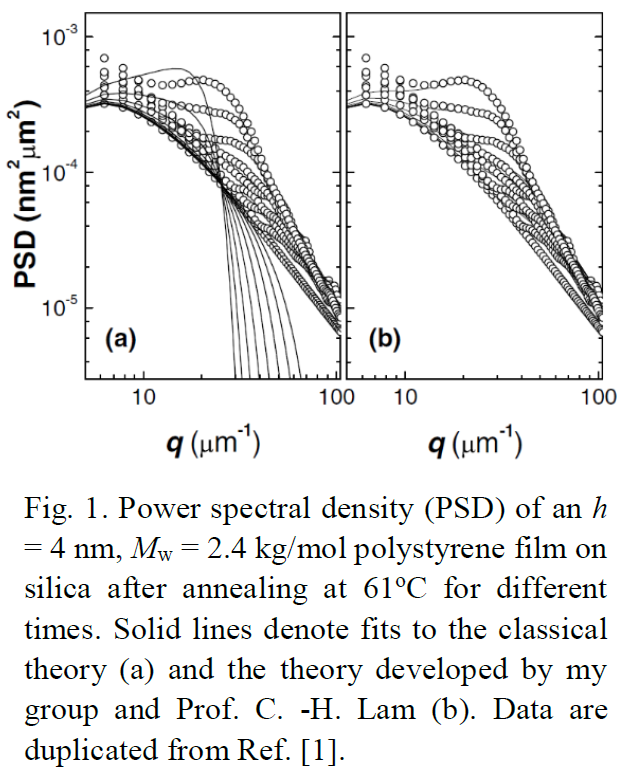
that it might be caused by spontaneous surface fluctuations in the films because of our observation that the dewetting morphology of spinodal-dewetting films often display both the bicontinuous structure (which is characteristic of spinodal processes) and sporadic nucleated holes. 2 By collaborating with Prof. C. -H. Lam of Hong Kong Polytechnic University, we incorporated thermal noise to the classical calculation, and attained a formulation that provided excellent agreement with experiment (Fig. 1(b)). From its fit to the data, we can deduce ƞeff, among other things. We found that heff typically increases with h for h < ~10–100 nm, but asymptotically approaches the bulk viscosity, ƞbulk, at large h or high temperature, T (Fig. 2). By assuming the films to be bilayers, consisting of a mobile layer with
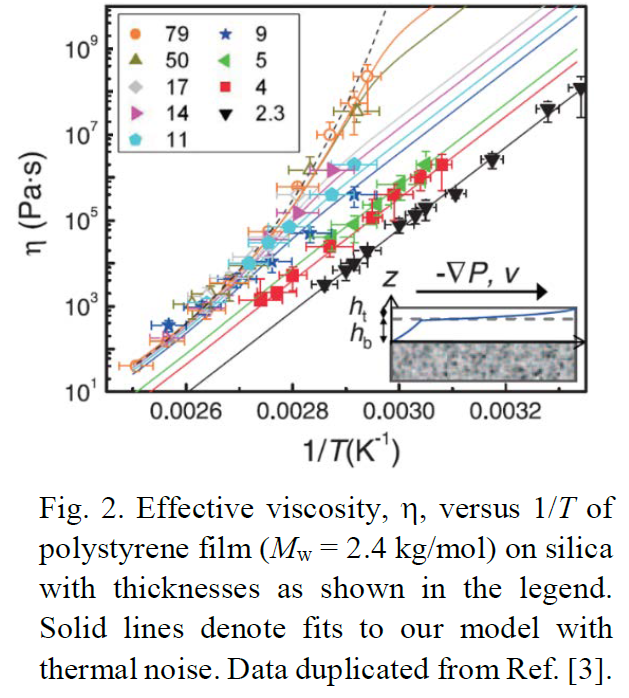
mobility (=h3/3ƞeff) 3 equal to that of the nanofilms(and so its viscosity is smaller than hbulk), and a bulk-like layer beneath (where the viscosity is equal to ƞbulk), we were able to fit all the data without any fitting parameters (Fig. 2). 3 The result shows that for unentangled, short-chain polymer films, the surface mobile layer is at most 2 nm (or about one Rg) thick, and the T-dependence of its mobility is Arrhenius (for the range of T studied). In contrast, the T dependence of the ƞeff of the bulk polymer is super-Arrhenius (Fig. 2), typical of glasses where molecular motions (beyond rattling ones) usually involve movements of multiple molecules and are hence cooperative. For entangled, long-chain polymer films, we augmented the original calculation to account for the viscoelasticity of the polymer dynamics, 4 and obtained a formulation that allows ƞeff in the terminal flow region to be determined. Our result shows that different from the heff of unentangled polymer nanofilms, that of the entangled polymer nanofilms is dominated by slippage at the substrate surface, 5 understood to be caused by the increasing effect of slippage in entangled polymer films with thickness reduction, besides other factors. Nevertheless, the surface mobile layer still plays an important role in the dynamics of these films. Specifically, our data indicated that the degree of slippage was anomalously enhanced when the substrate surface was brought closer to the substrate surface. 5 We surmise the enhancement to be connected with the higher mobility of the chain segments at the free surface, which may facilitate mobility enhancement at the substrate surface through chain connectivity, in a manner such as that suggested in the sliding chain model of the late de Gennes. 6
References:
1. Z. Yang, D. Peng, A. Clough, C.-H. Lam and O. K. C. Tsui, Eur. Phys. J. Special Topics, 2010, 189, 155-164. link
2. O. K. C. Tsui, Y. J. Wang, H. Zhao and B. Du, Eur. Phys. J. E, 2003, 12, 417-425. link
3. Z. Yang, Y. Fujii, F. K. Lee, C.-H. Lam and O. K. C. Tsui, Science, 2010, 328, 1676-1679. link
4. C.-H. Lam, O. K. C. Tsui and D. Peng, Langmuir, 2012, 28, 10217-10222. link
5. F. Chen, D. Peng, C.-H. Lam and O. K. C. Tsui, Macromolecules, 2015, 48, 5034-5039. link
6. P.-G. de Gennes, Eur. Phys. J. E, 2000, 2, 201-205.